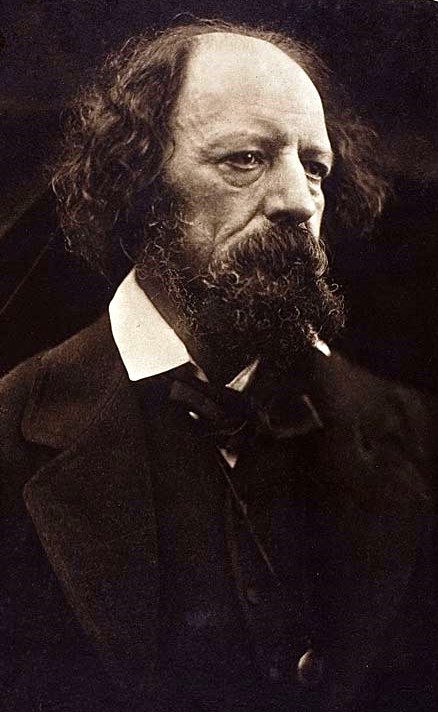
Alfred Tennyson Frases famosas
“O conhecimento vem e vai, mas a sabedoria permanece.”
Variante: O conhecimento chega, mas a sabedoria demora.
“Na primavera, a imaginação de um jovem volta-se, ligeira, para pensamentos de amor.”
In the Spring a young man's fancy lightly turns to thoughts of love. <br class="br">Locksley Hall (1842) <br class="br">tradução conforme citado em Revista Caras http://www.caras.com.br, Edição 674.
Alfred Tennyson frases e citações
“Sou parte de tudo que encontrei.”
I am a part of everything with which I come in contact
citado em "Report of the Minister of Education" - Página 75, de Ontario Dept. of Education - Publicado por Ontario Education Dept., 1887
“Não tem amigos o homem que nunca teve inimigos.”
He makes no friend who never made a foe <br class="br">Idylls of the King - Página 179 http://books.google.com/books?id=R8ssIlkxZDQC&pg=PA179, de Alfred Tennyson Tennyson, Alfred Tennyson - Publicado por Forgotten Books, 1862, ISBN 1605064807, 9781605064802 - 261 páginas
“Nossos espíritos se precipitaram um para o outro ao tocar dos lábios.”
our spirits rush'd together at the touching of the lips. <br class="br">Poems by Alfred Tennyson: In 2 Volumes - Volume 2 - Página 37 https://books.google.com.br/books?id=QalRAAAAcAAJ&pg=PA37, Alfred Tennyson - Ticknor & Comp., 1849
Alfred Tennyson: Frases em inglês
"Merlin and the Gleam", st. 3 (1889)
Alfred, Lord Tennyson The Lady of Shalott
Pt. IV, st. 6
The Lady of Shalott (1832)
Letter to Emily Sellwood, quoted in Alfred Lord Tennyson: A Memoir by His Son, by Hallam T. Tennyson (1897)
“Nor is he the wisest man who never proved himself a fool.”
Stanza 124
Locksley Hall Sixty Years After (1886)
Act iv, scene 3
Queen Mary: A Drama (published 1876)
“Be patient. Our Playwright may show
In some fifth act what this wild Drama means.”
The Play, reported in Bartlett's Familiar Quotations, 10th ed. (1919)
The First Quarrel, stanza VI., lines 3-4; reported in Bartlett's Familiar Quotations, 10th ed. (1919)
Part I, section xxii, stanza 1
Maud; A Monodrama (1855)
Alfred, Lord Tennyson The Charge of the Light Brigade
St. 5
The Charge of the Light Brigade (1854)
“Her manners had not that repose
Which stamps the caste of Vere de Vere.”
Alfred, Lord Tennyson Lady Clara Vere de Vere
Stanza 5
Lady Clara Vere de Vere (1832)
“In statesmanship
To strike too soon is oft to miss the blow.”
Act iii, scene 6
Queen Mary: A Drama (published 1876)
“The shell must break before the bird can fly.”
From The Ancient Sage (1885), line 154
“The night with sudden odour reeled;
The southern stars a music pealed.”
The Rosebud, reported in Bartlett's Familiar Quotations, 10th ed. (1919)
“…none can truly write his single day,
And none can write it for him upon earth.”
Unpublished Sonnet (originally written as a preface to Becket), in Alfred Lord Tennyson: A Memoir by His Son, by Hallam T. Tennyson (1897)
“Love will conquer at the last.”
Fonte: Locksley Hall Sixty Years After (1886), Line 280
“And ah for a man to arise in me,
That the man I am may cease to be!”
Part I, section x, stanza 6
Maud; A Monodrama (1855)
Alfred, Lord Tennyson The Foresters
Act I, Scene III
The Foresters, Robin Hood and Maid Marion (1892)
“The song that nerves a nation's heart
Is in itself a deed.”
Epilogue to The Charge of the Heavy Brigade, reported in Bartlett's Familiar Quotations, 10th ed. (1919)
" The Grandmother http://www.poetryconnection.net/poets/Alfred_Lord_Tennyson/14415", st. 8 (1864)
“That jewelled mass of millinery,
That oiled and curled Assyrian Bull.”
Part I, section vi, stanza 6
Maud; A Monodrama (1855)
Alfred, Lord Tennyson Tears, Idle Tears
St. 1
Tears, Idle Tears (1850)
“Insipid as the queen upon a card.”
Aylmer's Field (1864); reported in Bartlett's Familiar Quotations, 10th ed. (1919)
" Sea Dreams http://www.poetryconnection.net/poets/Alfred_Lord_Tennyson/14402" (1864) l. 301-303
“Authority forgets a dying king,
Laid widow’d of the power in his eye
That bow’d the will.”
Fonte: Morte D'Arthur (1842), Lines 121-123
Fonte: Locksley Hall Sixty Years After (1886), Line 131
Fonte: Locksley Hall Sixty Years After (1886), Line 275
"The Vision of Sin", sec. 5 (1842)