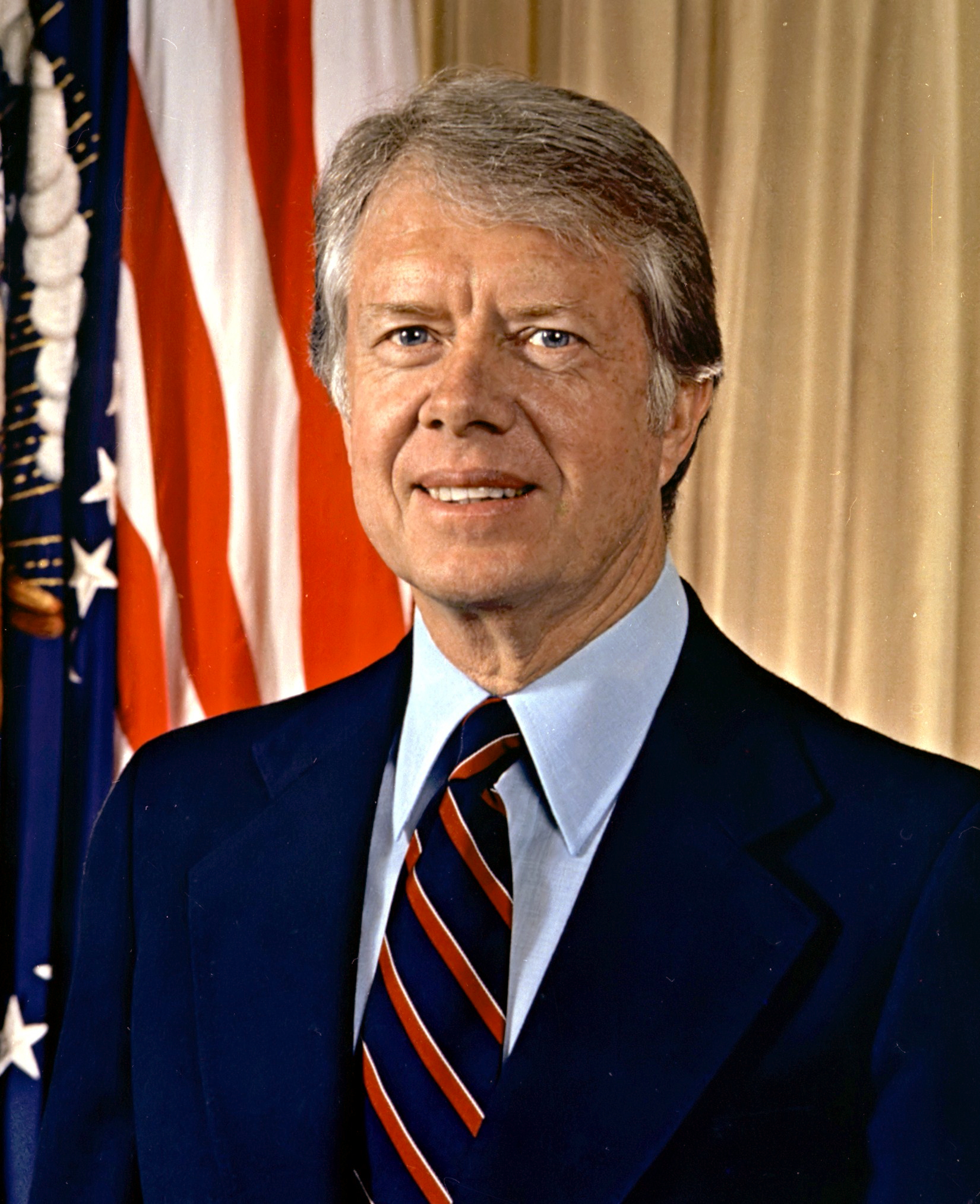
Jimmy Carter frases e citações
“Alguns requisitos internacionais básicos para uma eleição justa estão ausentes na Flórida.”
Jimmy Carter, ex-presidente americano, preocupado com a possibilidade de fraude nas eleições presidenciais na Flórida; citado em Veja, 06.10.04
Jimmy Carter: Frases em inglês
Variante: My faith demands - this is not optional - my faith demands that I do whatever I can, wherever I can, whenever I can, for as long as I can with whatever I have to try to make a difference.
Fonte: Sources of Strength: Meditations on Scripture for a Living Faith
Page 28
Post-Presidency, Our Endangered Values (2005)
Fonte: Our Endangered Values: America's Moral Crisis
Fonte: Through the Year with Jimmy Carter: 366 Daily Meditations from the 39th President
Presidency (1977–1981), Farewell Address (1981)
Contexto: We live in a time of transition, an uneasy era which is likely to endure for the rest of this century. During the period we may be tempted to abandon some of the time-honored principles and commitments which have been proven during the difficult times of past generations. We must never yield to this temptation. Our American values are not luxuries, but necessities— not the salt in our bread, but the bread itself.
Post-Presidency, Nobel lecture (2002)
Fonte: The Nobel Peace Prize Lecture
“America did not invent human rights. In a very real sense… human rights invented America.”
Presidency (1977–1981), Farewell Address (1981)
Contexto: America did not invent human rights. In a very real sense, it is the other way round. Human rights invented America.
Ours was the first nation in the history of the world to be founded explicitly on such an idea.
Contexto: I have just been talking about forces of potential destruction that mankind has developed, and how we might control them. It is equally important that we remember the beneficial forces that we have evolved over the ages, and how to hold fast to them.
One of those constructive forces is enhancement of individual human freedoms through the strengthening of democracy, and the fight against deprivation, torture, terrorism and the persecution of people throughout the world. The struggle for human rights overrides all differences of color, nation or language.
Those who hunger for freedom, who thirst for human dignity, and who suffer for the sake of justice — they are the patriots of this cause.
I believe with all my heart that America must always stand for these basic human rights — at home and abroad. That is both our history and our destiny.
America did not invent human rights. In a very real sense, it is the other way round. Human rights invented America.
Ours was the first nation in the history of the world to be founded explicitly on such an idea. Our social and political progress has been based on one fundamental principle — the value and importance of the individual. The fundamental force that unites us is not kinship or place of origin or religious preference. The love of liberty is a common blood that flows in our American veins.
“Human identity is no longer defined by what one does but rather by what one owns.”
Presidency (1977–1981), The Crisis of Confidence (1979)
Contexto: In a nation that was proud of hard work, strong families, close-knit communities, and our faith in God, too many of us now tend to worship self-indulgence and consumption. Human identity is no longer defined by what one does, but by what one owns.
Contexto: In a nation that was proud of hard work, strong families, close-knit communities, and our faith in God, too many of us now tend to worship self-indulgence and consumption. Human identity is no longer defined by what one does, but by what one owns. But we've discovered that owning things and consuming things does not satisfy our longing for meaning. We've learned that piling up material goods cannot fill the emptiness of lives which have no confidence or purpose.
The symptoms of this crisis of the American spirit are all around us. For the first time in the history of our country a majority of our people believe that the next 5 years will be worse than the past 5 years. Two-thirds of our people do not even vote. The productivity of American workers is actually dropping, and the willingness of Americans to save for the future has fallen below that of all other people in the Western world.
As you know, there is a growing disrespect for government and for churches and for schools, the news media, and other institutions. This is not a message of happiness or reassurance, but it is the truth and it is a warning.
These changes did not happen overnight. They've come upon us gradually over the last generation, years that were filled with shocks and tragedy.
We were sure that ours was a nation of the ballot, not the bullet, until the murders of John Kennedy and Robert Kennedy and Martin Luther King, Jr. We were taught that our armies were always invincible and our causes were always just, only to suffer the agony of Vietnam. We respected the Presidency as a place of honor until the shock of Watergate.
Jimmy Carter livro Palestine: Peace Not Apartheid
Fonte: Palestine: Peace Not Apartheid
Fonte: Beyond the White House: Waging Peace, Fighting Disease, Building Hope
Jimmy Carter livro A Call to Action: Women, Religion, Violence, and Power
Fonte: A Call to Action: Women, Religion, Violence, and Power
Presidency (1977–1981), 1977
"A Community of the Free" address at the The Foreign Policy Association NY, NY (23 June 1976); this is often paraphrased: We cannot be both the world’s leading champion of peace and the world’s leading supplier of the weapons of war.
Pre-Presidency
Contexto: Sometimes we try to justify this unsavory business on the cynical ground that by rationing out the means of violence we can somehow control the world’s violence. The fact is that we cannot have it both ways. Can we be both the world’s leading champion of peace and the world’s leading supplier of the weapons of war?


