Frases de I. L. Peretz

Isaac Leib Peretz

, também grafado às vezes como Yitskhok Leybush Peretz, mais conhecido como I. L. Peretz, foi um escritor, poeta e teatrólogo de língua iídiche da Polônia. Peretz, Mendele Mocher Sefarim e Sholem Aleichem são considerados os três grandes escritores clássicos em língua iídiche. Sol Liptzin escreveu: "Yitzkhok Leibush Peretz foi o grande despertador dos judeus de língua iídiche, e Sholem Aleichem seu consolador... Peretz despertou em seus leitores a vontade de autoemancipação, a vontade de resistência..."

Peretz rejeitou o universalismo cultural, vendo o mundo como composto de diferentes nações, cada uma com seu próprio caráter. Liptzin comenta que "Cada povo é visto por ele como um povo escolhido..."; ele viu como seu papel de escritor judeu exprimir "ideais judaicos... baseados na tradição judaica e história judaica."

Ao contrário de outros Maskilim, tinha grande respeito pelos judeus chassídicos por seu modo de ser no mundo; ao mesmo tempo, entendia a necessidade de levar em conta a fragilidade humana. Seus contos como "E Talvez Mais Alto", "Cabalistas" e "À Cabeceira do Moribundo" enfatizam a importância da devoção sincera, em vez da religiosidade vazia.Segundo J. Guinsburg, organizador e tradutor para o português de uma coletânea de contos de Peretz, "Peretz pode ser considerado como o verdadeiro modernizador da literatura iídiche. Não só porque, através de sua pena, ela ecoou conscientemente o tema social e socialista ou porque se abriu às estéticas literárias da Europa. Romântico, realista, simbolista, impressionista, admirador de Heine, Hamsun, Ibsen, Tchekhov, Górki e tantos outros poloneses, franceses, alemães, foi ele sobretudo o homem que instituiu o indivíduo, a subjetividade, a emoção pessoal, a análise psicológica e mesmo intimista, em uma literatura que até então não fora muito além do tipo, do esboço coletivo, da análise de costumes, da redução do real ao objetivo, ao externo."Segundo Mônica de Gouveia, "Peretz não era um poeta popular inocente, nem um seguidor do Hassidismo, mas incorporou o elemento popular e a religiosidade às suas próprias crenças e pontos de vista. Ele impôs sua própria experiência sobre este material popular e tradicional, modulando-o conforme sua expressão estética." Wikipedia  

✵ 18. Maio 1852 – 21. Março 1915
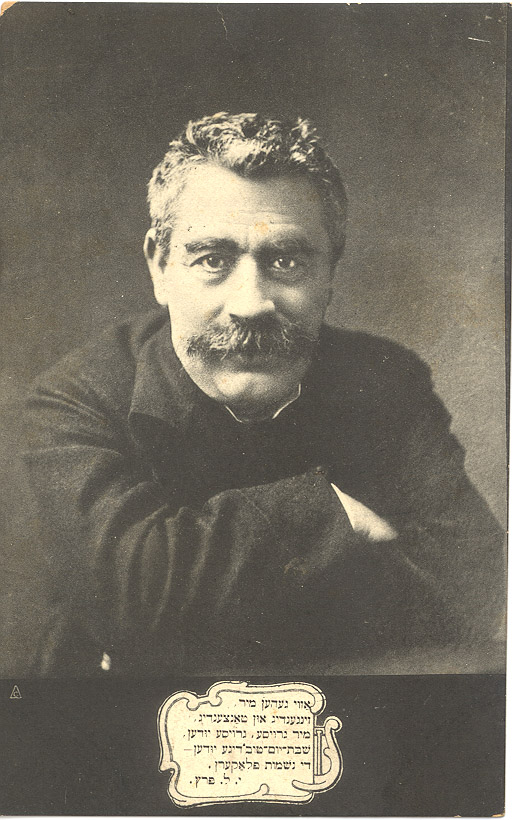
I. L. Peretz photo
I. L. Peretz: 61 citações0 Curtidas

I. L. Peretz: Frases em inglês

“Ghetto is impotence. Cultural cross-fertilization is the only possibility for human development.”

Isaac Leib Peretz

Vegn vos Firn op fun Yidishkeit, 1911. S. Liptzin. Peretz. Yivo, 1947, p. 378.
Contexto: We should get out of the ghetto, but we should get out as Jews, with our own spiritual treasures. We should interchange, give and take, but not beg. Ghetto is impotence. Cultural cross-fertilization is the only possibility for human development.

“You are lighting a fire beneath the open sky, while your own family in your own house is freezing.”

Isaac Leib Peretz

Bildung, 1890. Alle Verk, xii. 20ff. S. Liptzin. Peretz. Yivo, 1947, pp. 334–8.
Contexto: [About loyalty to Judaism] Don't assume, Jewish intellectuals, that you are doing your duty by working... for so-called Humanity.... You are lighting a fire beneath the open sky, while your own family in your own house is freezing.

“Genuine melody sings itself without a voice. It sings inside, within the heart, in man's very entrails!”

Isaac Leib Peretz

Mekubolim, 1906. Alle Verk, vi. 53.
Contexto: There are melodies that must have words... and melodies that sing themselves without words. The latter are of a higher grade. But these, too, depend on a voice and lips,... hence are not yet altogether pure, not yet genuine spirit. Genuine melody sings itself without a voice. It sings inside, within the heart, in man's very entrails!

“It is a key to open a heaven after death and not a key with which to force open the portals of this life.”

Isaac Leib Peretz

Vegn vos Firn op fun Yidishkeit, 1911. S. Liptzin. Peretz. Yivo, 1947, p. 372.
Contexto: They are all so-called Christian nations, but... this superimposed religion... does not penetrate into the core of their souls. It has no relation to their daily experience... It is a key to open a heaven after death and not a key with which to force open the portals of this life.

“The Hebrew language… is the only glue which holds together our scattered bones.”

Isaac Leib Peretz

Bildung, 1890. Alle Verk, xii. 14.
Contexto: The Hebrew language... is the only glue which holds together our scattered bones. It also holds together the rings in the chain of time.... It binds us to those who built pyramids, to those who shed their blood on the ramparts of Jerusalem, and to those who, at the burning stakes, cried Shema Yisrael!

“This means, in popular imagination, that bread and clothes shall grow, ready-made, on trees. Do you have more winged ideals?”

Isaac Leib Peretz

Advice to the Estranged. S. Liptzin. Peretz. Yivo, 1947, p. 348.
Contexto: A Jew waits for Messiah to come and redeem the world from fear and pain, from the cataclysmic conflicts between rich and poor. All shall enjoy the earth. This means, in popular imagination, that bread and clothes shall grow, ready-made, on trees. Do you have more winged ideals?

“There are melodies that must have words… and melodies that sing themselves without words.”

Isaac Leib Peretz

Mekubolim, 1906. Alle Verk, vi. 53.
Contexto: There are melodies that must have words... and melodies that sing themselves without words. The latter are of a higher grade. But these, too, depend on a voice and lips,... hence are not yet altogether pure, not yet genuine spirit. Genuine melody sings itself without a voice. It sings inside, within the heart, in man's very entrails!

“As victors, you may become the bureaucracy: doling out to each his bit as in a poorhouse, assigning to each his task as in a prison.”

Isaac Leib Peretz

Hofnung un Shrek, 1906. S. Liptzin. Peretz. Yivo, 1947, p. 279.
Contexto: I fear you. As victors, you may become the bureaucracy: doling out to each his bit as in a poorhouse, assigning to each his task as in a prison. And you will exterminate the creator of new worlds,—the free human will, and stop up the purest well of human happiness—the power of the one to face thousands, to stand up to peoples and generations.

“I am a rainworm, buried deep
Among the oozing, slimy things,
Yet of an eagle's nest I dream,
And eagle's wings.”

Isaac Leib Peretz

"I Am a Rainworm", 1900, translated by J. Robbins, (J. Leftwich. Golden Peacock. Sci-Art, 1939, p. 83).

“We are like fish
In this vast sea.
And Satan fishes
For you and me.”

Isaac Leib Peretz

"Monish" (translated in J. Leftwich. Golden Peacock. Sci-Art, 1939, p. 56.), 1888.

“Purim is the birthday of the first Schutz-Jude, the first Jewish toady to foreign royalty.”

Isaac Leib Peretz

Purim, 1896. Alle Verk, xii. 137. quoted in M. Samuel. Prince of the Ghetto. Alfred A. Knopf, 1948, p. 123.

“Ugliness is the greatest of all sins.”

Isaac Leib Peretz

Quoted by M. Samuel, Prince of the Ghetto, 146.

“A heap of bricks is not yet a house.”

Isaac Leib Peretz

A Gilgul fun a Nign, 1901. Alle Verk, 35; S. Liptzin. Peretz. Yivo, 1947, p. 239.

“Not all Hasidim are hasidim.”

Isaac Leib Peretz

Torah, 1906. Alle Verk, iv. 75.

“He who provides life provides also a living.”

Isaac Leib Peretz

Yohanan Melamed's Maaselech. Alle Verk, vi. 181.

Autores parecidos

Jules Verne photo
Jules Verne15
escritor francês None
Oscar Wilde photo
Oscar Wilde667
Escritor, poeta e dramaturgo britânico de origem irlandesa None
José Martí photo
José Martí14
edicoes em lingua portugues None
Hans Christian Andersen photo
Hans Christian Andersen2
escritor e poeta dinamarquês de histórias infantis None
Edgar Allan Poe photo
Edgar Allan Poe34
Escritor, poeta e crítico americano None
Victor Hugo photo
Victor Hugo391
poeta, romancista e dramaturgo francês None
Fiódor Dostoiévski photo
Fiódor Dostoiévski112
escritor russo None
Percy Bysshe Shelley photo
Percy Bysshe Shelley29
escritor britânico None
Ruy Barbosa photo
Ruy Barbosa69
político, escritor e jurista brasileiro None