“We are more than a people…. We are of a pure blood.”
Verk, edited by Kletzkin, xi. 277.
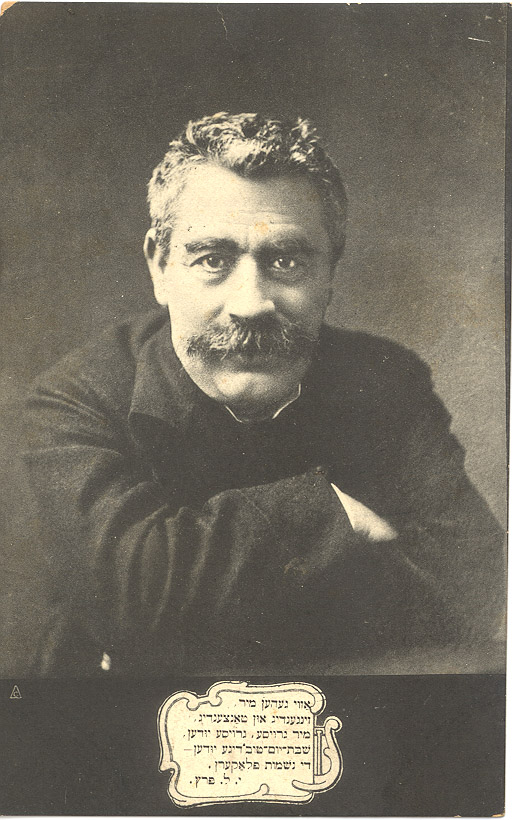
Isaac Leib Peretz
, também grafado às vezes como Yitskhok Leybush Peretz, mais conhecido como I. L. Peretz, foi um escritor, poeta e teatrólogo de língua iídiche da Polônia. Peretz, Mendele Mocher Sefarim e Sholem Aleichem são considerados os três grandes escritores clássicos em língua iídiche. Sol Liptzin escreveu: "Yitzkhok Leibush Peretz foi o grande despertador dos judeus de língua iídiche, e Sholem Aleichem seu consolador... Peretz despertou em seus leitores a vontade de autoemancipação, a vontade de resistência..."
Peretz rejeitou o universalismo cultural, vendo o mundo como composto de diferentes nações, cada uma com seu próprio caráter. Liptzin comenta que "Cada povo é visto por ele como um povo escolhido..."; ele viu como seu papel de escritor judeu exprimir "ideais judaicos... baseados na tradição judaica e história judaica."
Ao contrário de outros Maskilim, tinha grande respeito pelos judeus chassídicos por seu modo de ser no mundo; ao mesmo tempo, entendia a necessidade de levar em conta a fragilidade humana. Seus contos como "E Talvez Mais Alto", "Cabalistas" e "À Cabeceira do Moribundo" enfatizam a importância da devoção sincera, em vez da religiosidade vazia.Segundo J. Guinsburg, organizador e tradutor para o português de uma coletânea de contos de Peretz, "Peretz pode ser considerado como o verdadeiro modernizador da literatura iídiche. Não só porque, através de sua pena, ela ecoou conscientemente o tema social e socialista ou porque se abriu às estéticas literárias da Europa. Romântico, realista, simbolista, impressionista, admirador de Heine, Hamsun, Ibsen, Tchekhov, Górki e tantos outros poloneses, franceses, alemães, foi ele sobretudo o homem que instituiu o indivíduo, a subjetividade, a emoção pessoal, a análise psicológica e mesmo intimista, em uma literatura que até então não fora muito além do tipo, do esboço coletivo, da análise de costumes, da redução do real ao objetivo, ao externo."Segundo Mônica de Gouveia, "Peretz não era um poeta popular inocente, nem um seguidor do Hassidismo, mas incorporou o elemento popular e a religiosidade às suas próprias crenças e pontos de vista. Ele impôs sua própria experiência sobre este material popular e tradicional, modulando-o conforme sua expressão estética." Wikipedia
“We are more than a people…. We are of a pure blood.”
Verk, edited by Kletzkin, xi. 277.
“Nobody ever stubs his toe against a mountain. It's the little temptations that bring a man down.”
All for a Pinch of Snuff, c. 1910. Quoted in M. Samuel. Prince of the Ghetto. Alfred A. Knopf, 1948, p. 64.
“Who tells the truth needs no fancy phrases.”
Yohanan Melameds Maaselach, 1904. Alle Verk, vi. 181.
Sewing the Wedding Gown, 1906. Nine One-Act Plays from Yiddish. Translated by Bessie F. White, Boston, John W. Luce & Co., 1932, p. 127.
“A stranger's rose is but a thorn.”
In Alien Lands, translated by Leah W. Leonard.
“In this world it is very dangerous to be weak.”
Shreib a Feleton, 1895. Alle Verk, xii. 77.
"I Am a Rainworm", 1900, translated by Jacob Robbins. J. Leftwich. Golden Peacock. Sci-Art, 1939, p. 83.
The Day, 1906. Alle Verk, xii. 319. S. Liptzin. Peretz. Yivo, 1947, p. 18.
“To be of the eternal, you must be of the earth.”
Der Dichter, 1910. Alle Verk, x. 19.
Mesiras Nefesh, c. 1910. Alle Verk, vii. 142. M. Samuel. Prince of the Ghetto. Alfred A. Knopf, 1948, p. 22.
“If the husband sits on a chair in the Garden of Eden, his wife is his footstool.”
Sholom Bayis, 1889. S. Liptzin. Peretz. Yivo, 1947, p. 153.
“One God, one Law, one people, and one land.”
Der Dichter, 1910. Alle Verk, x. 21.
“Children… constitute man's eternity.”
Der Dichter, 1910. S. Liptzin. Peretz. Yivo, 1947, p. 321.
“At the Throne of Glory it is not the nobly-born that are beloved, but the nobly-risen.”
Drei Matones, c. 1910. Alle Verk, vii. 18.
Advice to the Estranged, S. Liptzin. Peretz. Yivo, 1947, p. 348.
“The bigger the merchant the smaller the Jew.”
"Fir Dores Fir Tzavoes", 1901. Alle Verk, iv. 237.
“Many refined people will not kill a fly, but eat an ox.”
Taanis Gedanken, 1896. Alle Verk, xii. 77.
“Prosperity may be found in small as in big business.”
Fir Dores Fir Tzavoes, 1901. Alle Verk, iv. 237.
Mesiras Nefesh, quoted in M. Samuel. Prince of the Ghetto. Alfred A. Knopf, 1948, p. 22.
“Human lips are now forbidden to utter His name, for being the only God, He needs no name.”
Der Dichter, 1910. Alle Verk, x. 23.
“Rather a stone, but to be alone!”
Oich a Feleton, 1894. Alle Verk, xii. 64.
Sewing the Wedding Gown, 1906. Nine One-Act Plays from Yiddish. Translated by Bessie F. White, Boston, John W. Luce & Co., 1932, p. 126.
Quoted in Jewish Affairs (Johannesburg), June 1952, p. 28. See Alle Verk, xii. 318.
Verk, edited by Kletzkin, xi. 277f.
“The worst dog gets the best bone.”
Mesiras Nefesh, c. 1910. Alle Verk, vii. 155.
“The song that from the heart would spring
Is dead for want of echoing.”
In Alien Lands, translated by Leah W. Leonard.
“A letter depends on how you read it, a melody on how you sing it.”
A Gilgul fun a Nign, 1901. Alle Verk, vi. 33.
Quoted in M. Samuel. Prince of the Ghetto. Alfred A. Knopf, 1948, p. 162.


