“As palavras podem ferir mais que punhais; e o tom, mais que as palavras.”
Frederico da Prússia em carta a Voltaire
Frederico II , também chamado de Frederico, o Grande, foi o Rei da Prússia de 1740 até sua morte. Ele é mais conhecido por suas vitórias militares, sua reorganização do exército prussiano, patronagem das artes e o iluminismo na Prússia.
Frederico, o grande, era conhecido como um amante da música, arte e literatura francesa. Infelizmente, para Frederico, seu pai não compartilhava seu amor às artes. O rei tentou moldar Frederico como uma imagem de si mesmo, um grande militar. Quando Frederico se rebelou contra sua educação, foi declarado traidor, encarcerado, ameaçado de execução e obrigado a assistir a decapitação de seu amigo, Hans Hermann von Katte. Casou-se com Isabel Cristina, filha do duque de Brunsvique-Volfembutel e sobrinha do imperador Carlos VI.
Frederico possuía um apelido carinhoso dado pelo povo prussiano, era chamado de O Velho Fritz.
O pai de Frederico não foi totalmente mal sucedido com seu filho. Apesar de Frederico nunca ter abandonado seu amor às artes, ele se tornou um grande líder militar, liderando as forças prussianas com sucesso em três guerras.
Ele era um grande estrategista que tinha a habilidade de impedir que forças opositoras se unissem contra ele.
Ao mesmo tempo em que se ocupava de seus interesses na literatura e na arte da guerra, Frederico também foi capaz de transformar a Prússia em uma potência econômica. Por esse vasto leque de sucessos dentro e fora dos campos de batalha, Frederico foi apelidado de "o Grande".
Amigo das letras, culto, grande colecionador de arte francesa, escritor com prosápias de filósofo, atraiu à Prússia, em torno de sua residência de Sans-Souci, Voltaire, com quem mantinha correspondência, e numerosos sábios franceses. Foi o tipo perfeito do déspota esclarecido do século XVIII. Deixou Memórias, em francês. Foi sucedido pelo seu sobrinho Frederico Guilherme. Wikipedia
“As palavras podem ferir mais que punhais; e o tom, mais que as palavras.”
Frederico da Prússia em carta a Voltaire
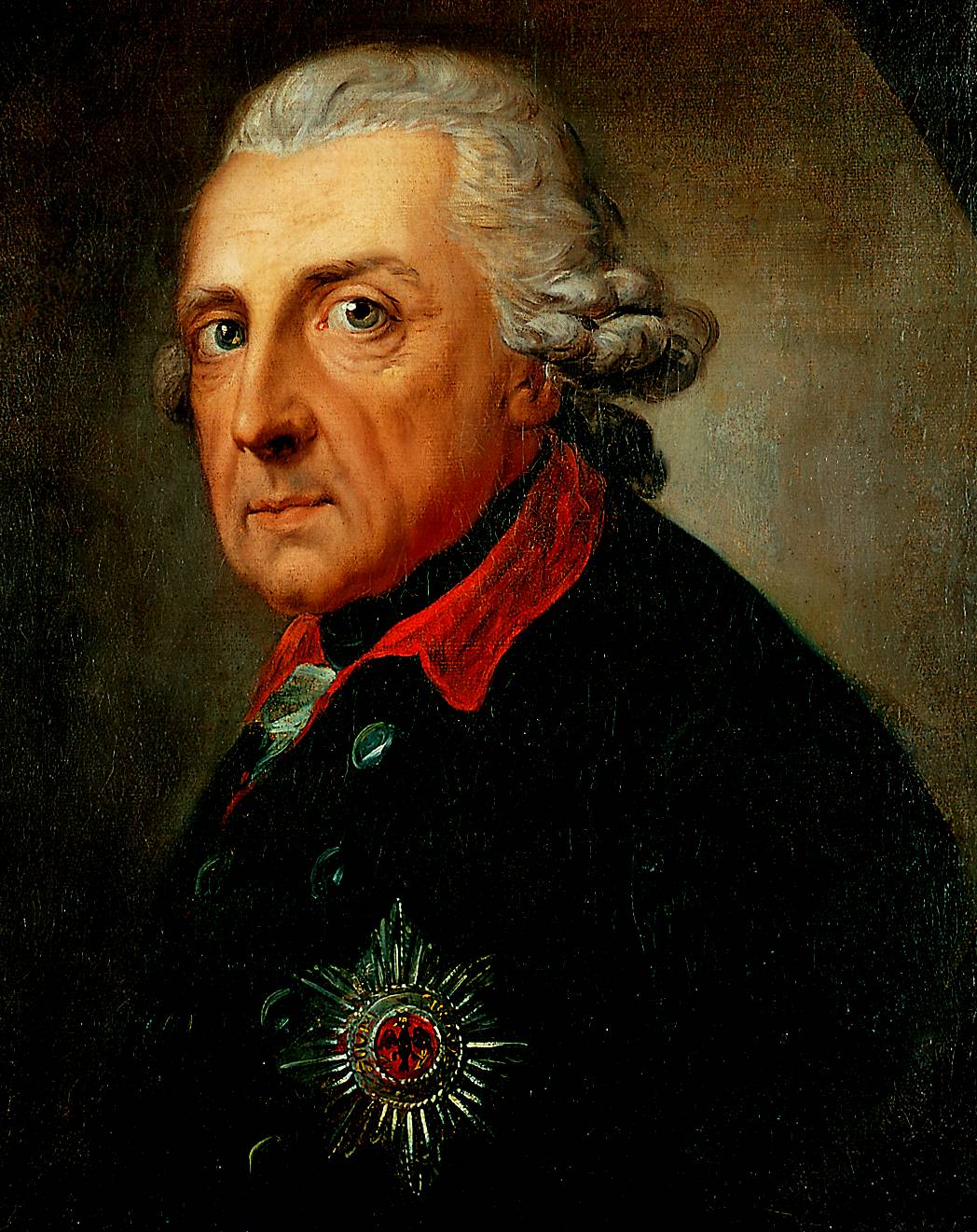
Frederico II, o Grande, rei da Prussia.
“O luxo não estimula o homem para a virtude, mas sufoca nele todos os sentimentos bons.”
Luxus treibt den Menschen zu keiner einzigen Tugend an, sondern erstickt meist alle besseren Gefühle in ihm.
Frederico II citado em "Dichter- und Denkerworte: 12000 Zitate und Sentenzen aus der Weltliteratur" - Página 922, de Werner Adolf Krüger - Editora Münster-Verlag, 1945 - 1935 páginas
“Rascals, would you live forever?”
To hesitant guards at the battle of Kolin https://en.wikipedia.org/wiki/Battle_of_Kol%C3%ADn#Battle, 18 June 1757 <br class="br">Attributed in E. M. Knowles, Oxford Dictionary Of Quotations (5th Edition) (Oxford University Press, 1999) <br class="br">"Kerels, wollt ihr den euwig leben?" Frederick the Great, by David Fraser, Penguin 2000, p. 353 Other versions have it: "Hünde, wollt ihr euwig leben?" (Dogs, do you want to live for ever?). <br class="br">Attributed
“Audacity, audacity, always audacity!”
Il nous faut de l'audace, encore de l'audace, toujours de l'audace! http://www.gutenberg.org/dirs/etext04/8dscs10.txt <br class="br">We must dare, dare again, always dare! <br class="br">Georges Danton, speech, Assemblée legislative, Paris (1792-09-02), reported in Le Moniteur (1792-09-04) <br class="br">Misattributed
1777; quoted by Bert L. Vallée, Alcohol in the Western World, Scientific American, Vol. 278, No. 6 (June), 1998, pp. 80-85
Kindle edition
Attributed
Je voulus faire un jet d’eau dans mon jardin; Euler calcula l’effort des roues pour faire monter l’eau dans un bassin, d’où elle devait retomber par des canaux, afin de jaillir à Sans-Souci. Mon moulin a été exécuté géométriquement, et il n’a pu élever une goutte d’eau à cinquante pas du bassin. Vanité des vanités! vanité de la géométrie!
Letter H 7434 from Frederick to Voltaire (1778-01-25)
Frederick II of Prussia livro Anti-Machiavel
Fonte: Anti-Machiavel, Ch. 6 : New States That The Prince Acquires By His Valor And His Own Weapons
“If my soldiers began to think, not one would remain in the ranks.”
Attributed in J.A. Houlding, Fit for Service: The Training of the British Army, 1715-1795 (Oxford, 1981)
Attributed
Preface to “Histoire de mon temps”, Works (1743), quoted in W. W. Coole (ed.), Thus Spake Germany (London: George Routledge & Sons, 1941), p. 82
Fonte: Speech at the Academy of Berlin of 27 January 1772 (inside Luca de Samuele Cagnazzi, Saggio sopra i principali metodi d'istruire i fanciulli https://books.google.it/books?id=BUdCqC_j9z8C&newbks=1&newbks_redir=0&hl=it&pg=PA12#v=onepage&q&f=false - 1819 - pp. 12-13 )
Frederick II of Prussia livro Anti-Machiavel
Fonte: Anti-Machiavel, Ch. 5 : How It Is Necessary To Control The Cities, Or The Principalities, Which Are Controlled By Their Own Laws Before They Were Conquered
Frederick II of Prussia livro Anti-Machiavel
Fonte: Anti-Machiavel, Chapter VIII
Letters of Voltaire and Frederick the Great (New York: Brentano's, 1927), trans. Richard Aldington, letter 37 from Frederick to Voltaire (June 1738)
Attributed by Thomas Babington Macaulay, Life of Frederick the Great (1882), pg 48.
Repeated by Thomas Babington Macaulay in a review of "Frederick the Great and his Times. Edited, with an Introduction, by Thomas Campbell, Esq". Edinburgh Review, ISSN 1751-8482, 04/1842, Volume 75, Issue 151, p. 241-242, though it does not appear in the original work.
Knowles, Oxford Dictionary Of Quotations (5th Edition) (Oxford University Press, 1999)
Attributed
Letters of Voltaire and Frederick the Great (New York: Brentano's, 1927), trans. Richard Aldington, letter 215 from Frederick to Voltaire (1776-03-19)
Frederick II of Prussia livro Anti-Machiavel
Fonte: Anti-Machiavel, Ch. 1 : What A Strong Prince Really Is, And How One Can Reach That Point
Ich empfinde für das göttliche Wesen die tiefste Verehrung und hüte mich deshalb sehr, ihm ein ungerechtes, wankelmütiges Verhalten zuzuschreiben, das man beim geringsten Sterblichen verurteilen würde. Aus diesem Grunde, liebe Schwester, glaube ich lieber nicht, dass das allmächtige, gütige Wesen sich im mindesten um die menschlichen Angelegenheiten kümmert. Vielmehr schreibe ich alles, was geschieht, den Geschöpfen und notwendigen Wirkungen unberechenbarer Ursachen zu und beuge mich schweigend vor diesem anbetungswürdigen Wesen, indem ich meine Unwissenheit über seine Wege eingestehe, die mir zu offenbaren seiner göttlichen Weisheit nicht gefallen hat.
Letter to princess Amalie von Preußen
Frederick II of Prussia livro Anti-Machiavel
Fonte: Anti-Machiavel, Chapter IX
Frederick II of Prussia livro Anti-Machiavel
Fonte: Anti-Machiavel, Chapter XIV
Frederick II of Prussia livro Anti-Machiavel
Foreword
Anti-Machiavel
Letters of Voltaire and Frederick the Great (New York: Brentano's, 1927), trans. Richard Aldington, letter 221 from Frederick to Voltaire (1777-11-25)
Frederick II of Prussia livro Anti-Machiavel
Fonte: Anti-Machiavel, Ch. 6 : New States That The Prince Acquires By His Valor And His Own Weapons
Frederick II of Prussia livro Anti-Machiavel
Fonte: Anti-Machiavel, Chapter IV
Frederick II of Prussia livro Anti-Machiavel
Fonte: Anti-Machiavel, Ch. 5 : How It Is Necessary To Control The Cities, Or The Principalities, Which Are Controlled By Their Own Laws Before They Were Conquered
Frederick II of Prussia livro Anti-Machiavel
Fonte: Anti-Machiavel, Chapter VII
Letters of Voltaire and Frederick the Great (New York: Brentano's, 1927), trans. Richard Aldington, letter 141 from Frederick to Voltaire (1759-07-02)
“Like a long boat which follows in the wake of the warship to which it is tied.”
On the decline of the Dutch Republic subject to British power
Attributed in T. C. W. Blanning, The Eighteenth Century (Oxford, 2000)
Attributed
Military Instructions (1747), Article II: Of the Subsistence of Troops, and of Provisions http://www.sonshi.com/frederickthegreat1-2.html
Frederick II of Prussia livro Anti-Machiavel
Fonte: Anti-Machiavel, Ch. 3 : Mixed Principalities


