“Não se pode explicar alguma coisa meramente lhe dando um nome.”
Death in Midsummer and Other Stories
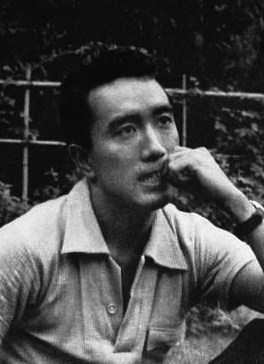
Yukio Mishima , pseudônimo de Kimitake Hiraoka foi um novelista e dramaturgo japonês mundialmente conhecido por romances como bra: O Templo do Pavilhão Dourado /prt: O Templo Doirado 金閣寺 e Cores Proibidas . Escreveu mais de 40 novelas, poemas, ensaios e peças modernas de teatro Kabuki e Nô. Wikipedia
“Não se pode explicar alguma coisa meramente lhe dando um nome.”
Death in Midsummer and Other Stories
“Eu não tinha nenhum prazer na derrota - muito menos na vitória - sem ter lutado.”
Yukio Mishima livro Sun and Steel
I had no taste for defeat — much less victory — without a fight.
Sun and Steel (1968) - pag. 49, Traduzido por John Bester (2003), Oxford University Press ISBN 4-770-02903-9
Yukio Mishima livro Runaway Horses
Runaway Horses
Death in Midsummer and Other Stories
“Um onnagata é uma criança nascida da união ilícita entre sonho e realidade.”
Death in Midsummer and Other Stories
Yukio Mishima livro The Temple of the Golden Pavilion
The Temple of the Golden Pavilion
Death in Midsummer and Other Stories
Variante: Quando o grande sacerdote olha para o rico e para o nobre, ele sorri com compaixão e imagina como é possível que essas pessoas não distingam os prazeres pelos sonhos vazios que são. Quando ele percebe belas mulheres, sua única reação é a piedade que sente pelos homens que habitam o mundo de desilusão e que são lançados às ondas do prazer carnal.
A partir do momento que um homem não mais responde, da maneira que for, às razões que regulam o mundo material, este mundo parecer estar em total repouso. Aos olhos do grande sacerdote o mundo aparenta apenas repouso; tornou-se uma mera figura num pedaço de papel, um mapa de uma terra distante. Quando se adquire um estado de espírito cujas paixões malignas do mundo presente foram completamente extinguidas, o medo também é extinguido. Assim o sacerdote já não é capaz de conceber porque o inferno deveria existir.
Yukio Mishima livro Sun and Steel
Fonte: Sun and Steel (1968), p. 9.
Contexto: Words are a medium that reduces reality to abstraction for transmission to our reason, and in their power to corrode reality inevitably lurks the danger that the words will be corroded too. It might be more appropriate, in fact, to liken their action to excessive stomach fluids that digest and gradually eat away the stomach itself.
Many people will express disbelief that such a process could already be at work in a person's earliest years. But that, beyond doubt, is what happened to me personally, thereby laying the ground for two contradictory tendencies within myself. One was the determination to press ahead loyally with the corrosive function of words, and to make that my life's work. The other was the desire to encounter reality in some field where words should play no part at all.
Yukio Mishima livro Confessions of a Mask
Fonte: Confessions of a Mask (1949), p. 153.
Contexto: My "act" has ended by becoming an integral part of my nature, I told myself. It's no longer an act. My knowledge that I am masquerading as a normal person has even corroded whatever of normality I originally possessed, ending by making me tell myself over and over again that it too was nothing but a pretense of normality. To say it another way, I'm becoming the sort of person who can't believe in anything except the counterfeit.
Yukio Mishima livro The Sailor Who Fell from Grace with the Sea
Fonte: The Sailor Who Fell from Grace with the Sea
“Anything can become excusable when seen from the standpoint of the result”
Yukio Mishima livro The Temple of the Golden Pavilion
Fonte: The Temple of the Golden Pavilion
Yukio Mishima livro The Temple of the Golden Pavilion
Fonte: The Temple of the Golden Pavilion
Yukio Mishima livro Runaway Horses
Fonte: Runaway Horses
Yukio Mishima livro Confessions of a Mask
Fonte: Confessions of a Mask (1949), p. 208.
Contexto: I received an impassioned letter from Sonoko. There was no doubt that she was truly in love. I felt jealous. Mine was the unbearable jealousy a cultured pearl must feel toward a genuine one. Or can there be such a thing in this world as a man who is jealous of the woman who loves him, precisely because of her love?
Yukio Mishima livro The Sailor Who Fell from Grace with the Sea
Fonte: The Sailor Who Fell from Grace with the Sea
Yukio Mishima livro Confessions of a Mask
Fonte: Confessions of a Mask (1949), p. 220.
“I had no taste for defeat — much less victory — without a fight.”
Yukio Mishima livro Sun and Steel
Fonte: Sun and Steel (1968), p. 49.
Yukio Mishima livro The Sound of Waves
Fonte: The Sound of Waves (1956), p. 31, ch. 4.
“Is there not a sort of remorse that precedes sin? Was it remorse at the very fact that I existed?”
Yukio Mishima livro Confessions of a Mask
Fonte: Confessions of a Mask (1949), p. 144.
Ryuji, the sailor in The Sailor Who Fell From Grace With The Sea (1965), p. 38.
Yukio Mishima livro Runaway Horses
Runaway Horses (1969), as translated by Michael Gallagher (1973).
Yukio Mishima livro Sun and Steel
Fonte: Sun and Steel (1968), p. 57.
Yukio Mishima on Hagakure : The Samurai Ethic and Modern Japan (1977) as translated by Kathryn Sparling, p. 105; Mishima's commentary on the sayings of Yamamoto Tsunetomo.
Yukio Mishima livro Spring Snow
Spring Snow (1968), as translated by Michael Gallagher (1972).
“As he saw it, there was only one choice — to be strong and upright, or to commit suicide.”
Yukio Mishima Ken
"Sword" ("Ken"), quoted in 三島由紀夫短編集: Seven Stories, translated by John Bester (2002), p. 46.
Yukio Mishima Ken
"Sword" ("Ken"), quoted in 三島由紀夫短編集: Seven Stories, translated by John Bester (2002), p. 67.
"Raisin Bread", quoted in 三島由紀夫短編集: Seven Stories, translated by John Bester (2002), p. 21.
Yukio Mishima livro Runaway Horses
Runaway Horses (1969), as translated by Michael Gallagher (1973).
Yukio Mishima livro Confessions of a Mask
Fonte: Confessions of a Mask (1949), p. 115.
"Cigarette" ("Ta- bako") story, quoted in 三島由紀夫短編集: Seven Stories, translated by John Bester (2002), p. 110.
"The Priest of Shiga Temple and His Love" in Death in Midsummer, and Other Stories (1966), p. 59.
"Cigarette" ("Ta- bako") story, quoted in 三島由紀夫短編集: Seven Stories, translated by John Bester (2002), p. 110.
Yukio Mishima livro The Temple of the Golden Pavilion
The Temple of the Golden Pavilion (1959).
[At the movie's ending, speaking to the soldiers]
Final address (1970)