“Se deve dizer e pensar de algo que é: porque existe o ser, não entretanto o não-ser.”
Fragmento B6
original grego: "χρὴ τὸ λὲγειν τε νοεῖν τ᾿ ἐὸν ἔμμεναι: ἔστι γὰρ εἶναι, μηδὲν δ᾿ οὐκ ἔστιν·"
Parmênides ou Parménides de Eleia foi um filósofo grego natural de Eleia, uma cidade grega na costa sul da Magna Grécia. Supostamente de família rica, seus primeiros contatos filosóficos foram com a escola pitagórica, especialmente com Ameinias. O único trabalho conhecido de Parménides é um poema, Sobre a natureza, que sobreviveu apenas na forma de fragmentos. Neste poema, Parménides descreve duas visões da realidade. Em "O caminho da verdade" , ele explica como realidade é uma, a mudança é impossível enquanto a existência é atemporal, uniforme, necessária e imutável.
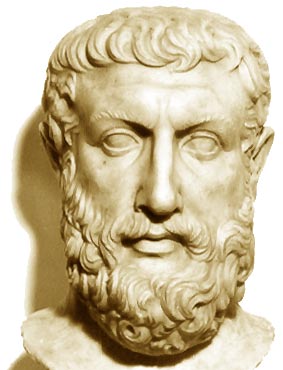
“Se deve dizer e pensar de algo que é: porque existe o ser, não entretanto o não-ser.”
Fragmento B6
original grego: "χρὴ τὸ λὲγειν τε νοεῖν τ᾿ ἐὸν ἔμμεναι: ἔστι γὰρ εἶναι, μηδὲν δ᾿ οὐκ ἔστιν·"
“It is indifferent to me where I am to begin, for there shall I return again.”
Frag. B 5, quoted by Proclus, Commentary on the Parmenides, 708
“For it is the same thing that can be thought and that can be.”
Frag. B 3, quoted by Plotinus, Enneads V, i.8
Frag. B 2.2-6, quoted by Proclus, Commentary on the Timaeus I, 345
Frag B 1.28-30, quoted by Sextus Empiricus, Against the Mathematicians, vii. 3; Simplicius, Commentary on the Heavens, 557-8; Proclus, Commentary on the Timaeus I, 345
Frag. B 8.1-4, quoted by Simplicius, Commentary on the Physics, 144
Frag. B 7.1-2, quoted by Plato, Sophist, 237a
Frag. B 7.3-8.1, quoted by Sextus Empiricus, Against the Mathematicians, vii. 3


