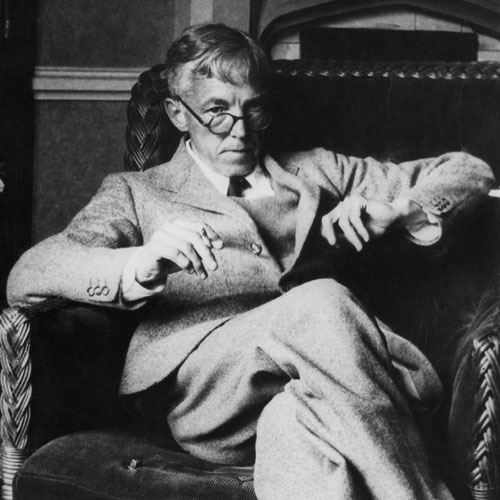
"The Theory of Numbers," Nature (Sep 16, 1922) Vol. 110 https://books.google.com/books?id=1bMzAQAAMAAJ p. 381
G. H. Hardy: 20 citações0 Curtidas
G. H. Hardy: Frases em inglês
G. H. Hardy livro A Mathematician's Apology
A Mathematician's Apology (1941)
G. H. Hardy livro A Mathematician's Apology
A Mathematician's Apology (1941)
“I am interested in mathematics only as a creative art.”
G. H. Hardy livro A Mathematician's Apology
Fonte: A Mathematician's Apology (1941)
G. H. Hardy livro A Mathematician's Apology
A Mathematician's Apology (1941)
G. H. Hardy livro A Mathematician's Apology
A Mathematician's Apology (1941)
G. H. Hardy livro A Mathematician's Apology
A Mathematician's Apology (1941)
G. H. Hardy livro A Mathematician's Apology
Quoted by C. P. Snow in his introduction to reprints of the book.
A Mathematician's Apology (1941)
G. H. Hardy livro A Mathematician's Apology
A Mathematician's Apology (1941)
G. H. Hardy livro A Mathematician's Apology
A Mathematician's Apology (1941)
“Chess problems are the hymn-tunes of mathematics.”
G. H. Hardy livro A Mathematician's Apology
A Mathematician's Apology (1941)
G. H. Hardy livro A Mathematician's Apology
A Mathematician's Apology (1941)
G. H. Hardy livro A Mathematician's Apology
A Mathematician's Apology (1941)
G. H. Hardy livro A Mathematician's Apology
A Mathematician's Apology (1941)
G. H. Hardy livro A Mathematician's Apology
A Mathematician's Apology (1941)
Fonte: Ramanujan (1940), Ch. I : The Indian mathematician Ramanujan.
G. H. Hardy livro A Mathematician's Apology
A Mathematician's Apology (1941)
G. H. Hardy livro A Mathematician's Apology
A Mathematician's Apology (1941)
Fonte: Ramanujan (1940), Ch. I : The Indian mathematician Ramanujan.
“If I knew I was going to die today, I think I should still want to hear the cricket scores.”
Fonte: Quoted in The Joy of Cricket (ed. John Bright-Holmes, 1984)