“Nossos companheiros perfeitos nunca têm menos de quatro patas.”
Nos compagnons parfaits n'ont jamais moins de quatre pattes.
"Sammlung" - página 240, Colette, Claude Pichois, Roberte Forbin - Flammarion, 1973 - 454 páginas
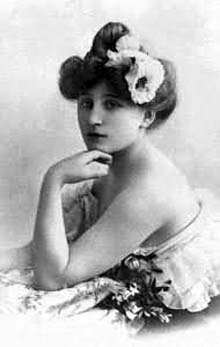
Sidonie Gabrielle Colette foi uma escritora francesa.
Filha de um veterano de guerra. Possuía uma enorme colecção de objectos de Art Nouveau, e mantinha um salão literário.
Em sua obra "Chéri", publicada em 1920, escreve sobre o relacionamento de uma mulher madura com um homem 24 anos mais novo. Wikipedia
“Nossos companheiros perfeitos nunca têm menos de quatro patas.”
Nos compagnons parfaits n'ont jamais moins de quatre pattes.
"Sammlung" - página 240, Colette, Claude Pichois, Roberte Forbin - Flammarion, 1973 - 454 páginas
The woman who thinks she is intelligent demands equal rights with men. A woman who is intelligent does not.
citado em "Dictionary of Quotations" - Página 89, Connie Robertson - Wordsworth Editions, 1998, ISBN 185326489X, 9781853264894 - 669 páginas
Atribuídas
“Nunca toque em uma asa de borboleta com seu dedo.”
Never touch a butterfly's wing with your finger.
"Break of day: a novel" - página 23, Colette - Farrar, Straus and Cudahy, 1961 - 143 páginas
“Total ausência de humor torna a vida impossível.”
Total absence of humor renders life impossible.
"Colette of the Academy Goncourt" - página 270, Colette - Farrar, Straus & Young, 1952 - 315 páginas
Put down everything that comes into your head and then you're a writer. But an author is one who can judge his own stuff's worth, without pity, and destroy most of it.
citado em "Casual change" - página 115, Alan Houghton Brodrick - Hutchinson, 1961 - 224 páginas
Atribuídas
“Que vida maravilhosa que eu tinha! Quem me dera que tivesse percebido isso mais cedo.”
"Well, go and see what a wonderful life I've had". ... "I only wish I'd realised it sooner"
citado em "Madame Colette: a provincial in Paris" - página 212, Margaret Crosland - P. Owen,1953 - 222 páginas
Atribuídas
“Até que é bom as crianças, ocasionalmente e com polidez, colocarem os pais no seu lugar.”
It is no bad thing that children should occasionally, and politely, put parents in their proper place.
"My mother's house" - página 30, Colette - Secker & Warburg, 1969 - 219 páginas
“É aconselhável aplicar o óleo refinado da cortesia para os mecanismos da amizade.”
It is wise to apply the oil of refined politeness to the mechanisms of friendship.
"Earthly Paradise" - página 412, Colette - Farrar, Straus & Giroux, 1970, ISBN 0374634009, 9780374634001 - 505 páginas
“Você irá fazer coisas idiotas, mas irá fazê-las com entusiasmo.”
You will do foolish things, but do them with enthusiasm.
New York World-Telegram and Sun (1961)
“Escrever só leva a escrever mais.”
Writing only leads to more writing
citado em "Creating Colette: From baroness to woman of letters, 1912-1954" - página 235, Claude Francis, Fernande Gontier - Steerforth Press, 1999, ISBN 1883642760, 9781883642761 - 298 páginas
Atribuídas
“Se você está lidando com um animal ou uma criança, convencer é enfraquecer.”
Qu'il s'agisse d'une bête ou d'un enfant, convaincre c'est affaiblir
"Œuvres complètes: Volume 9" - página 125, Colette - Le Fleuron, se vend chez Flammarion, 1948
“Quando ela levanta as pálpebras é como se ela tirasse todas as suas roupas.”
When she raises her eyelids it's as if she were taking off her clothes
"Claudine and Annie" - página 42, Colette - Penguin, 1972 - 159 páginas
I love my past. I love my present. I'm not ashamed of what I've had, and I'm not sad because I have it no longer.
"Seven" - página 219, Colette - Farrar, Straus and Cudahy, 1955
My true friends have always given me that supreme proof of their attachment: a spontaneous aversion to the man I loved.
"A lesson in love" - página 13, Colette - Farrar & Rinehart, incorporated, 1932 - 237 páginas
“Nós só fazemos as coisas que gostamos de fazer.”
We only do well the things we like doing
"Earthly Paradise" - página 281, Colette - Farrar, Straus & Giroux, 1970, ISBN 0374634009, 9780374634001 - 505 páginas
“Você não nota as alterações que aconteceram antes de você.”
You do not notice changes in what is always before you.
"My apprenticeships [and] Music-hall sidelights" - página 65, Colette - Penguin, 1967 - 218 páginas
“O verdadeiro viajante é ele quem vai a pé e, mesmo assim, ele senta-se grande parte do tempo.”
The true traveler is he who goes on foot, and even then, he sits down a lot of the time
"Earthly Paradise" - página 4444, Colette - Farrar, Straus & Giroux, 1970, ISBN 0374634009, 9780374634001 - 505 páginas
“Para um poeta, o silêncio é uma resposta aceitável, até mesmo um elogio.”
To a poet, silence is an acceptable response, even a flattering one.
"Earthly Paradise" - página 443, Colette - Farrar, Straus & Giroux, 1970, ISBN 0374634009, 9780374634001 - 505 páginas
“Que encantamento fazer amizade com alguém que você desprezava.”
Atribuídas <br class="br">Fonte: Revista Caras http://www.caras.com.br, edição 679, de Novembro de 2006.
Connaître ce qui lui était caché, c'est la griserie, l'honneur et la perte de l'homme.
citado em "Le dictionnaire des citations du monde entier", Karl Petit - Gérard, 1960 - 478 páginas
Atribuídas
“Ser feliz. É a única maneira de ser sábio.”
Be happy. It's one way of being wise.
citado em "Worldwide Laws of Life: 200 Eternal Spiritual Principles" - Página 154, John Marks Templeton - Templeton Foundation Press, 1998, ISBN 1890151157, 9781890151157 - 528 páginas
Atribuídas
“Creio que o mais urgente e incomparável desperdício de tempo é o que chamamos de sofrimento.”
I believe that there are more urgent and honorable occupations than that incomparable waste of time we call suffering.
citado em "Recovering, a journal" - página 7, May Sarton - G.K. Hall, 1981, ISBN 0816131880, 9780816131884 - 351 páginas
Atribuídas
“Os defeitos dos maridos muitas vezes são causados pelo excesso de virtudes de suas esposas.”
The faults of husbands are often caused by the excess virtues of their wives
citado em "Webster's II new Riverside desk quotations", James Beasley Simpson - Houghton Mifflin, 1992, ISBN 0395620244, 9780395620243 - 420 páginas
Atribuídas
Colette livro Break of Day
Break of Day (1928)
“Nothing ages a woman like living in the country.”
L'Envers du music hall (Music Hall Sidelights), "On Tour" (1913)
In Gigi, and Selected Writings (1963).
“It is not a bad thing that children should occasionally, and politely, put parents in their place.”
My Mother’s House, "The Priest on the Wall" (1922)
“We only do well the things we like doing.”
Prisons and Paradise (1932)
“You will do foolish things, but do them with enthusiasm.”
New York World-Telegram and Sun (1961)
Barks and Purrs
Contexto: Toby-Dog: It seems to me that of the two of us it's you they make the most of, and yet you do all the grumbling.
Kiki-The-Demure: A dog's logic, that! The more one gives the more I demand.
Toby-Dog: That's wrong. It's indiscreet.
Kiki-The-Demure: Not at all. I have a right to everything.
Toby-Dog: To everything? And I?
Kiki-The-Demure: I don't imagine you lack anything, do you?
Toby-Dog: Ah, I don't know. Sometimes in my very happiest moments, I feel like crying. My eyes grow dim, my heart seems to choke me. I would like to be sure, in such times of anguish, that everybody loves me; that there is nowhere in the world a sad dog behind a closed door, that no evil will ever come...
Kiki-The-Demure: And then what dreadful thing happens?
Toby-Dog: You know very well! Inevitably, at that moment She appears, carrying a bottle with horrible yellow stuff floating in it — Castor Oil!
Freedom (1908)
Fonte: Oeuvres complètes en seize volumes
Colette Chéri
Fonte: La Fin de Chéri (The Last of Cheri) (1926)
“Total absence of humor renders life impossible.”
Chance Acquaintances (1952)
Fonte: Chance Acquaintances and Julie de Carneilhan
“What a delight it is to make friends with someone you have despised!”
“Sido and I”, Earthly Paradise (1966) ed. Robert Phelps