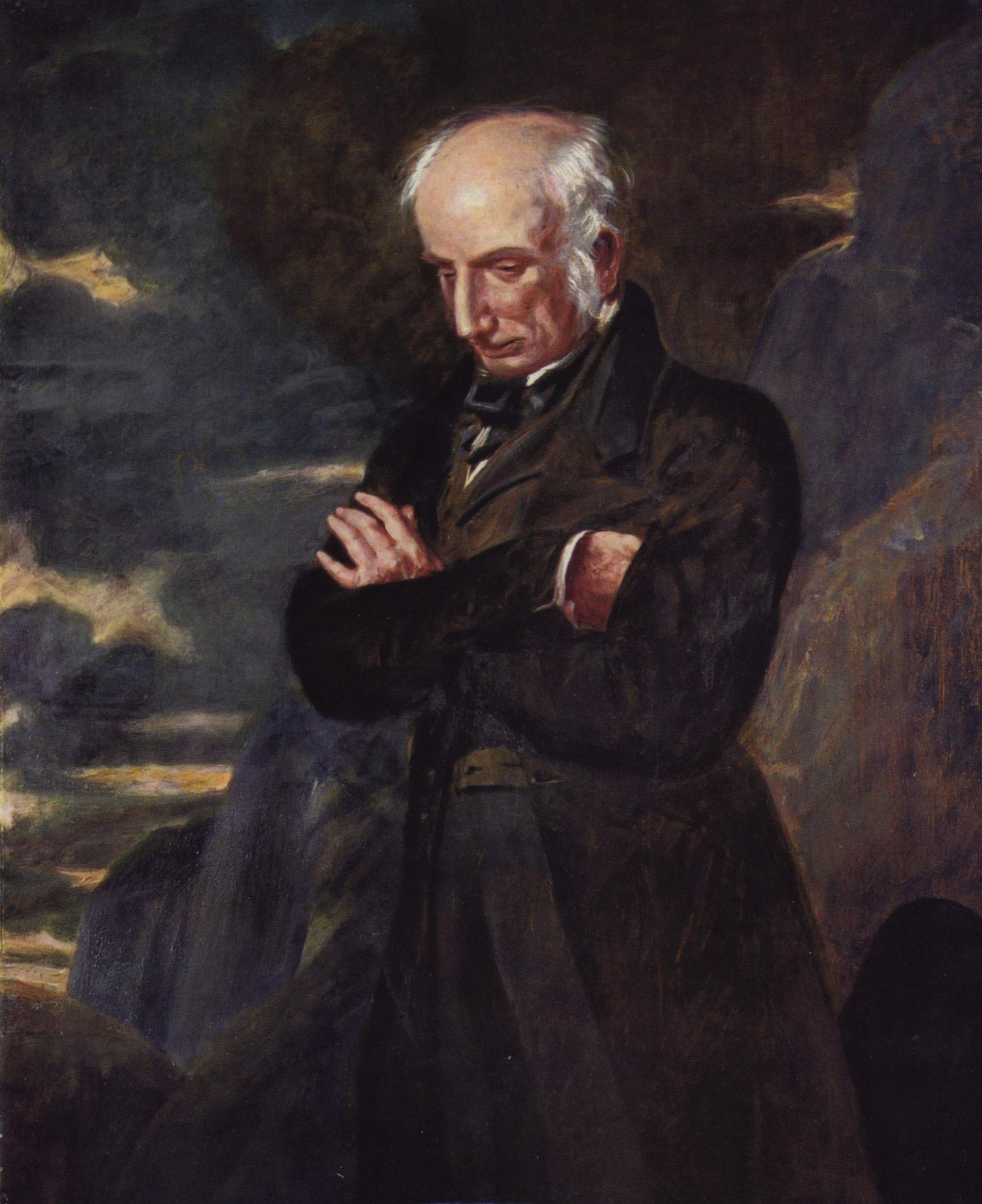
William Wordsworth Frases famosas
True beauty dwells in deep retreats, Whose veil is unremoved Till heart with heart in concord beats, And the lover is beloved. <br class="br">The poetical works of William Wordsworth: in eight volumes, Volume 4 - Página 177 http://books.google.com.br/books?id=I7IDAAAAQAAJ&pg=PA177, D. Bryce, 1827
William Wordsworth: Frases em inglês
“A living thing
Produced too slowly ever to decay;
Of form and aspect too magnificent
To be destroyed.”
Yew-Trees, l. 9 (1803).
Contexto: Of vast circumference and gloom profound,
This solitary Tree! A living thing
Produced too slowly ever to decay;
Of form and aspect too magnificent
To be destroyed.
The River Duddon, sonnet 34 - Afterthought, l. 13 (1820).
William Wordsworth livro Lyrical Ballads
Stanza 4.
Lyrical Ballads (1798–1800), Lines written a few miles above Tintern Abbey (1798)
Contexto: If I should be, where I no more can hear
Thy voice, nor catch from thy wild eyes these gleams
Of past existence, wilt thou then forget
That on the banks of this delightful stream
We stood together; And that I, so long
A worshipper of Nature, hither came,
Unwearied in that service: rather say
With warmer love, oh! with far deeper zeal
Of holier love. Now wilt thou then forget,
That after many wanderings, many years
Of absence, these steep woods and lofty cliffs,
And this green pastoral landscape, were to me
More dear, both for themselves, and for thy sake.
William Wordsworth livro Lyrical Ballads
Preface.
Fonte: Lyrical Ballads (1798–1800)
“The music in my heart I bore
Long after it was heard no more.”
Fonte: Great Narrative Poems Of The Romantic Age
Variante: Though nothing can bring back the hour
Of splendor in the grass, of glory in the flower;
We will grieve not, rather find
Strength in what remains behind;
In the primal sympathy
Which having been must ever be...
Fonte: Ode: Intimations Of Immortality From Recollections Of Early Childhood
William Wordsworth livro Lyrical Ballads
Expostulation and Reply, st. 5 (1798).
Fonte: Lyrical Ballads (1798–1800)
“My heart leaps up when I behold
A rainbow in the sky”
My Heart Leaps Up When I Behold, (1802)
The last three lines of this form the introductory lines of the long Ode: Intimations of Immortality from Recollections of Early Childhood begun the next day.
Contexto: My heart leaps up when I behold
A rainbow in the sky:
So was it when my life began;
So is it now I am a man;
So be it when I shall grow old,
Or let me die!
The Child is father of the Man;
And I could wish my days to be
Bound each to each by natural piety.
“Habit rules the unreflecting herd.”
Part II, No. 28 - Reflections.
Ecclesiastical Sonnets (1821)
William Wordsworth livro Lyrical Ballads
Stanza 3.
Fonte: Lyrical Ballads (1798–1800), Lines written a few miles above Tintern Abbey (1798), Lines Composed a Few Miles Above Tintern Abbey
Contexto: That time is past,
And all its aching joys are now no more,
And all its dizzy raptures. Not for this
Faint I, nor mourn nor murmur, other gifts
Have followed; for such loss, I would believe,
Abundant recompence. For I have learned
To look on nature, not as in the hour
Of thoughtless youth; but hearing oftentimes
The still, sad music of humanity,
Nor harsh nor grating, though of ample power
To chasten and subdue. And I have felt
A presence that disturbs me with the joy
Of elevated thoughts; a sense sublime
Of something far more deeply interfused,
Whose dwelling is the light of setting suns,
And the round ocean and the living air,
And the blue sky, and in the mind of man;
A motion and a spirit, that impels
All thinking things, all objects of all thought,
And rolls through all things. Therefore am I still
A lover of the meadows and the woods,
And mountains; and of all that we behold
From this green earth; of all the mighty world
Of eye, and ear,—both what they half create,
And what perceive; well pleased to recognise
In nature and the language of the sense,
The anchor of my purest thoughts, the nurse,
The guide, the guardian of my heart, and soul
Of all my moral being.
William Wordsworth The World Is Too Much with Us
The World Is Too Much with Us, l. 9 (1806).
Stanza 1. <br class="br"> I Wandered Lonely as a Cloud http://www.bartleby.com/145/ww260.html (1804) <br class="br">Fonte: I Wander'd Lonely as a Cloud
“poetry is the breath and finer spirit of knowledge”
William Wordsworth livro Lyrical Ballads
Fonte: Lyrical Ballads
“… and we shall find
A pleasure in the dimness of the stars.”
William Wordsworth livro Lyrical Ballads
Fonte: Lyrical Ballads
William Wordsworth livro Lyrical Ballads
The Tables Turned, st. 6 (1798).
Lyrical Ballads (1798–1800)
“The Child is father of the Man;
And I could wish my days to be
Bound each to each by natural piety.”
My Heart Leaps Up When I Behold, (1802)
The last three lines of this form the introductory lines of the long Ode: Intimations of Immortality from Recollections of Early Childhood begun the next day.
Contexto: My heart leaps up when I behold
A rainbow in the sky:
So was it when my life began;
So is it now I am a man;
So be it when I shall grow old,
Or let me die!
The Child is father of the Man;
And I could wish my days to be
Bound each to each by natural piety.