“Personally, people know themselves very poorly.”
Contributions to the analysis of the sensations (1897), translated by Cora May Williams, published by Open Court Publishing Company, p. 4
19th century
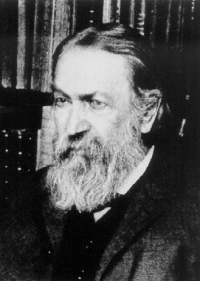
Ernst Waldfried Josef Wenzel Mach foi um físico e filósofo austríaco.De 1864 a 1867 foi professor de matemática em Graz. Depois lecionou física na Universidade Carolina, quando opôs-se à introdução da língua tcheca como idioma oficial na mesma universidade, alinhando-se entre os partidários da dominação alemã na região. De 1895 a 1901 foi o titular da cadeira de história e teoria da ciência indutiva na Universidade de Viena. Em 1901, após abandonar o ensino, foi nomeado membro da Câmara dos Pares pelo imperador da Áustria.
Suas obras filosóficas e científicas exerceram profunda influência no pensamento do século XX. Seus primeiros livros contêm os fundamentos de uma nova teoria filosófica, o empirocriticismo. Defendeu uma concepção positivista: nenhuma proposição das ciências naturais é admissível se não for possível verificá-la empiricamente. Wikipedia
“Personally, people know themselves very poorly.”
Contributions to the analysis of the sensations (1897), translated by Cora May Williams, published by Open Court Publishing Company, p. 4
19th century
3rd edition, p. 318ff, As quoted by Phillip Frank, Philosophy of Science: The Link Between Science and Philosophy (1957)
20th century, "Erkenntnis und Irrtum: Skizzen zur Psychologie der Forschung" (1905)
Fonte: 20th century, The Analysis of Sensations (1902), p. 23, as quoted in Lenin as Philosopher: A Critical Examination of the Philosophical Basis of Leninism (1948) by Anton Pannekoek, p. 454
Fonte: 20th century, Popular Scientific Lectures, (Chicago, 1910), p. 205; On aim of research.
Mach (1910) "Die Leitgedanken meiner naturwissenschaftlichcn Erkennenislehre und ihr Aufnahme durch die Zeitgenossen", Physikalische Zeitschrift. 1, 1910, 599-606 Eng. trans. as "The Guiding Principles of my Scientific Theory of Knowledge and its Reception by my Contemporaries", in S. Toulmin ed., Physical Reality, New York : Harper, 1970. pp.28-43. Cited in: K. Mulligan & B. Smith (1988) " Mach and Ehrenfels: Foundations of Gestalt Theory http://ontology.buffalo.edu/smith/articles/mach/mach.pdf" <br class="br">20th century
"On the Relative Educational Value of the Classics and the Mathematico-Physical Sciences in Colleges and High Schools", an address in (16 April 1886), published in Popular Scientific Lectures (1898), as translated by Thomas J. McCormack, p. 367
19th century
sensation-complexes
Fonte: 20th century, The Analysis of Sensations (1902), p. 23, as quoted in Lenin as Philosopher: A Critical Examination of the Philosophical Basis of Leninism (1948) by Anton Pannekoek, p. 33
"The Economical Nature of Physical Inquiry," in Popular Scientific Lectures (1898), p. 192
19th century
Fonte: 19th century, Popular Scientific Lectures [McCormack] (Chicago, 1898), p. 197; On mathematics and counting.
Fonte: 20th century, "Populär-wissenschafliche Vorlesungen" (1908), pp. 224-225: On thought-economy in m., 203.
Fonte: 20th century, Popular Scientific Lectures, (Chicago, 1910), p. 196: Mathematics seems possessed of intelligence
Fonte: 20th century, Popular Scientific Lectures, (Chicago, 1910), p. 205; On the space of experience.