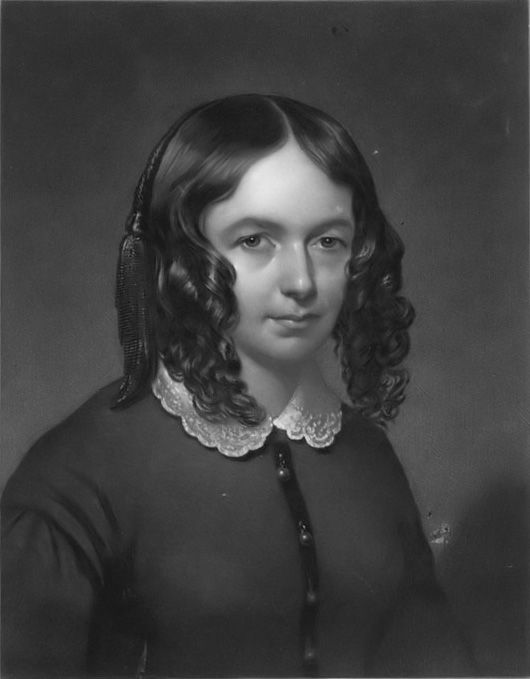
Elizabeth Barrett Browning: 93 citações6 Curtidas
Elizabeth Barrett Browning Frases famosas
“Homens adquirem Opiniões como os meninos aprendem a soletrar: pela repetição.”
People get opinions in the same way that children learn spelling - by repetition. <br class="br">Elizabeth Barrett Browning citada em Telling It Like It Is - Página 72 http://books.google.com.br/books?id=w8_p1eGVj8gC&pg=PA72, Paul Bowden - Paul Bowden, 2011, ISBN 1461095611, 9781461095613, 698 páginas
Elizabeth Barrett Browning: Frases em inglês
St. 22.
De Profundis (1862)
Contexto: Whatever's lost, it first was won;
We will not struggle nor impugn.
Perhaps the cup was broken here,
That Heaven's new wine might show more clear.
I praise Thee while my days go on.
Elizabeth Barrett Browning livro Sonnets from the Portuguese
No. LXII
Sonnets from the Portuguese (1850)
Elizabeth Barrett Browning livro Sonnets from the Portuguese
No. LXI
Sonnets from the Portuguese (1850)
A Woman's Shortcomings http://www.poetryconnection.net/poets/Elizabeth_Barrett_Browning/14908, st. 5 (1850). <br class="br">Contexto: Unless you can muse in a crowd all day<br>On the absent face that fixed you;<br>Unless you can love, as the angels may,<br>With the breadth of heaven betwixt you;<br>Unless you can dream that his faith is fast,<br>Through behoving and unbehoving;<br>Unless you can die when the dream is past —<br>Oh, never call it loving!
Bk. VII, l. 801-808. <br class="br"> Aurora Leigh http://digital.library.upenn.edu/women/barrett/aurora/aurora.html (1857) <br class="br">Contexto: Man, the two-fold creature, apprehends<br>The two-fold manner, in and outwardly,<br>And nothing in the world comes single to him.<br>A mere itself, — cup, column, or candlestick,<br>All patterns of what shall be in the Mount;<br>The whole temporal show related royally,<br>And build up to eterne significance<br>Through the open arms of God.
Bk. VII, l. 801-808. <br class="br"> Aurora Leigh http://digital.library.upenn.edu/women/barrett/aurora/aurora.html (1857) <br class="br">Contexto: Man, the two-fold creature, apprehends<br>The two-fold manner, in and outwardly,<br>And nothing in the world comes single to him.<br>A mere itself, — cup, column, or candlestick,<br>All patterns of what shall be in the Mount;<br>The whole temporal show related royally,<br>And build up to eterne significance<br>Through the open arms of God.
St. 23 -24.
De Profundis (1862)
Contexto: p>I praise Thee while my days go on;
I love Thee while my days go on:
Through dark and dearth, through fire and frost,
With emptied arms and treasure lost,
I thank Thee while my days go on.And having in thy life-depth thrown
Being and suffering (which are one),
As a child drops his pebble small
Down some deep well, and hears it fall
Smiling — so I. THY DAYS GO ON.</p
“Because God's gifts put man's best dreams to shame.”
Elizabeth Barrett Browning livro Sonnets from the Portuguese
No. XXVI
Sonnets from the Portuguese (1850)
“What I do, and what I dream include thee, as the wine must taste of its own grapes.”
Fonte: Sonnets from the Portuguese and Other Poems
“My patience has dreadful chilblains from standing so long on a monument.”
Fonte: Letters of Elizabeth Barrett Browning to Mary Russell Mitford, 1836-1854
Elizabeth Barrett Browning livro Sonnets from the Portuguese
Fonte: Sonnets from the Portuguese
“Witch, scholar, poet, dreamer, and the rest…”
Elizabeth Barrett Browning livro Aurora Leigh
Fonte: Aurora Leigh
Elizabeth Barrett Browning livro Sonnets from the Portuguese
Fonte: Sonnets from the Portuguese
Elizabeth Barrett Browning livro Sonnets from the Portuguese
No. IV
Sonnets from the Portuguese (1850)
“Go from me. Yet I feel that I shall stand
Henceforward in thy shadow.”
Elizabeth Barrett Browning livro Sonnets from the Portuguese
No. VI
Sonnets from the Portuguese (1850)
Elizabeth Barrett Browning livro Sonnets from the Portuguese
No. IV
Sonnets from the Portuguese (1850)
“Since when was genius found respectable?”
Bk. VI, l. 275. <br class="br"> Aurora Leigh http://digital.library.upenn.edu/women/barrett/aurora/aurora.html (1857)
“By thunders of white silence.”
Hiram Powers's Greek Slave; reported in Bartlett's Familiar Quotations, 10th ed. (1919).
St. 20-21.
De Profundis (1862)
Bk. II, l. 785-790. <br class="br"> Aurora Leigh http://digital.library.upenn.edu/women/barrett/aurora/aurora.html (1857)
“Oh, the little birds sang east, and the little birds sang west.”
Toll Slowly; reported in Bartlett's Familiar Quotations, 10th ed. (1919).
The Dead Pan; reported in Bartlett's Familiar Quotations, 10th ed. (1919)..