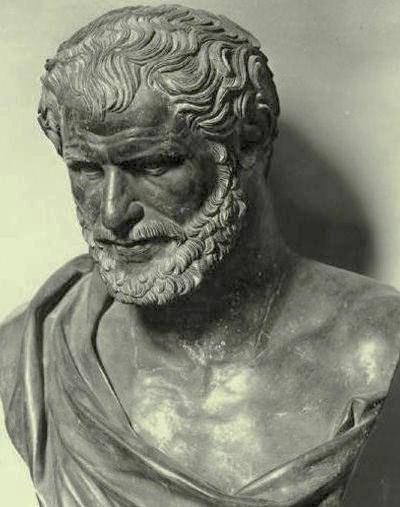

Demócrito Frases famosas
Citações de idade de Demócrito
citado em "Ancilla to the Pre-Socratic Philosophers: A Complete Translation of the Fragments in Diels" - página 142 http://books.google.com/books?id=ASijqFryr5IC&pg=PA142, item 9., Kathleen Freeman, Forgotten Books, 1948, ISBN 1606802569, 9781606802564 <br class="br">Física e epistemologia
Fragmento 237
Ética
Fonte: Pré-socráticos, coleção Os Pensadores
Frag. 198
Ética
Fonte: Pré-socráticos, coleção Os Pensadores
“Na realidade, vemos nada, porque a verdade está na profundidade.”
Fragment 117
Física e epistemologia
Citações de homens de Demócrito
“O homem só é infeliz quando é injusto.”
Atribuídas
Variante: O homem não é infeliz, enquanto não é injusto.
“O caráter de um homem faz o seu destino.”
Variante: O carácter de um homem faz o seu destino.
“O que faz o homem feliz não é o dinheiro, mas a retidão e a prudência.”
Fonte: http://www.caras.uol.com.br - 12 de novembro de 2009 - EDIÇÃO 836 - Citações http://caras.uol.com.br/citacoes/edicoes/836/
Demócrito frases e citações
frag. 202
Ética
Fonte: Pré-socráticos, coleção Os Pensadores
Frag. 3
Ética
Fonte: Pré-socráticos, coleção Os Pensadores
“"Sábio é quem não se aflige com o que lhe falta e se alegra com o que possui."Frag. 231”
Ética
Fonte: Pré-socráticos, coleção Os Pensadores
fragmento 181
Ética
Fonte: Pré-socráticos, coleção Os Pensadores
Demócrito: Frases em inglês
“Immoderate desire is the mark of a child, not a man.”
Freeman (1948), p. 152
Variante: It is childish, not manly, to have immoderate desires.
Freeman (1948), p. 163
Variante: The brave man is he who overcomes not only his enemies but his pleasures. There are some men who are masters of cities but slaves to women.
Source Book in Ancient Philosophy (1907), The Fragments
“He who does wrong is more unhappy than he who suffers wrong.”
Source Book in Ancient Philosophy (1907), The Golden Sayings of Democritus
“Throw moderation to the winds, and the greatest pleasures bring the greatest pains.”
Source Book in Ancient Philosophy (1907), The Golden Sayings of Democritus
“There are many who know many things, yet are lacking in wisdom.”
Source Book in Ancient Philosophy (1907), The Golden Sayings of Democritus
“In a shared fish, there are no bones.”
Freeman (1948), p. 157
Source Book in Ancient Philosophy (1907), The Golden Sayings of Democritus
Source Book in Ancient Philosophy (1907), The Fragments
Freeman (1948), p. 161
Variante: The good things of life are produced by learning with hard work; the bad are reaped of their own accord, without hard work.
“No one deserves to live who has not at least one good-man-and-true for a friend.”
Source Book in Ancient Philosophy (1907), The Golden Sayings of Democritus
“Good breeding in cattle depends on physical health, but in men on a well-formed character.”
Freeman (1948), p. 151
Durant (1939), Ch. XVI, §II, p. 354; citing C. Bakewell, Sourcebook in Ancient Philosophy, New York, 1909, "Fragment 57"
Variante: Strength of body is nobility only in beasts of burden, strength of character is nobility in man.
Variante: In cattle excellence is displayed in strength of body; but in men it lies in strength of character.
“A sensible man takes pleasure in what he has instead of pining for what he has not.”
Source Book in Ancient Philosophy (1907), The Golden Sayings of Democritus
“The friendship of one wise man is better than the friendship of a host of fools.”
Source Book in Ancient Philosophy (1907), The Golden Sayings of Democritus
Source Book in Ancient Philosophy (1907), The Golden Sayings of Democritus
“Tis well to restrain the wicked, and in any case not to join him in his wrong-doing.”
Source Book in Ancient Philosophy (1907), The Golden Sayings of Democritus
“Tis a grievous thing to be subject to an inferior.”
Source Book in Ancient Philosophy (1907), The Golden Sayings of Democritus
Freeman (1948), p. 170
Variante: By desiring little, a poor man makes himself rich.
“My enemy is not the man who wrongs me, but the man who means to wrong me.”
Source Book in Ancient Philosophy (1907), The Golden Sayings of Democritus
Source Book in Ancient Philosophy (1907), The Golden Sayings of Democritus
Source Book in Ancient Philosophy (1907), The Golden Sayings of Democritus
Source Book in Ancient Philosophy (1907), The Golden Sayings of Democritus
“Medicine heals diseases of the body, wisdom frees the soul from passions.”
Freeman (1948), p. 149
Variante: Medicine cures the diseases of the body; wisdom, on the other hand, relieves the soul of its sufferings.
“Fools learn wisdom through misfortune.”
Source Book in Ancient Philosophy (1907), The Golden Sayings of Democritus
“False men and shams talk big and do nothing.”
Source Book in Ancient Philosophy (1907), The Golden Sayings of Democritus
Freeman (1948), p. 166
Variante: Envy is the cause of political division.
“Good means not [merely] not to do wrong, but rather not to desire to do wrong.”
Source Book in Ancient Philosophy (1907), The Golden Sayings of Democritus
“Disease of the home and of the life comes about in the same way as that of the body.”
Freeman (1948), p. 170
Variante: Disease occurs in a household, or in a life, just as it does in a body.