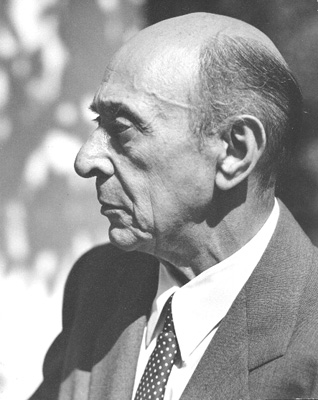
Arnold Schönberg Frases famosas
Sobre o compositor Giacomo Puccini
"La morte di Puccini mi ha recato un profondo dolore. Non avrei mai creduto di non dover più rivedere questo così grande uomo. E sono rimasto orgoglioso di aver suscitato il suo interesse, e Le sono riconoscente che Ella lo abbia fatto sapere ai miei nemici in un recente suo articolo."
Arnold Schönberg, carta a Alfredo Casella, janeiro de 1925 ( Wikipédia italiana )
Arnold Schönberg: Frases em inglês
“…if it is art, it is not for all, and if it is for all, it is not art.”
Arnold Schoenberg livro Style and Idea
from New Music, Outmoded Music, Style and Idea (1946); as quoted in Style and Idea (1985), p. 124
1940s
“I was never revolutionary. The only revolutionary in our time was Strauss!”
Schoenberg, Arnold. 1975, in Style and Idea: Selected Writings of Arnold Schoenberg. Edited by Leonard Stein, with translations by Leo Black. p. 137
after 1930
"An Artistic Impression" (1909) in Style and Idea (1985), p. 190
before 1930
“I see the work as a whole first. Then I compose the details.”
As quoted in an interview with José Rodriguez (c. 1936) in Schoenberg (1971) by Merle Armitage, p. 149
after 1930
Contexto: I see the work as a whole first. Then I compose the details. In working out, I always lose something. This cannot be avoided. There is always some loss when we materialize. But there is compensating gain in vitality.
Arnold Schoenberg, (1946); as quoted in A Schoenberg reader - Documents of a life, edited by Joseph Auner, Yale University Press 2003, page 316-17
1940s
As quoted in an interview with José Rodriguez (c. 1936) in Schoenberg (1971) by Merle Armitage, p. 143
1930s
"About Music Criticism" (1909), in Style and Idea (1985), p. 196
1900s
Note of 1944; as quoted in the Charles Ives profile at Decca Classics http://www.deccaclassics.com/music/composers/ives.html <br class="br">1940s
“My works are 12-tone compositions, not 12-tone compositions”
Stuckenschmidt, Hans Heinz. 1977, in Schoenberg: His Life, World and Work; translated from the German by Humphrey Searle. p. 349.
after 1930
“My music is not modern, it is merely badly played”
Genette, Gérard. 1997. Immanence and Transcendence, translated by G. M. Goshgarian. p. 102
Undated
In a letter to Wassily Kandinsky, 18 Dec. 1911; as quoted in Schönberg and Kandinsky: An Historic Encounter, by Klaus Kropfinger; edited by Konrad Boehmer; published by Routledge (imprint of Taylor & Francis, an Informa Group company), 2003, p. 15-16 note 49
1910s
“I am delighted to add another unplayable work to the repertoire.”
On his Violin Concerto (Op. 36), as quoted in Schoenberg (1971) by Merle Armitage, p. 149
Undated
“Hauer looks for laws. Good. But he looks for them where he will not find them.”
"Hauer's Theories" (Notes of 9 May 1923), in Style and Idea (1985), p. 209
1920s
“There are no more geniuses, only critics.”
"Those Who Complain about the Decline" (1923), in Style and Idea (1985), p. 203
1920s
"Hauer's Theories" (Notes of November 1923), in Style and Idea (1985), p. 210
1920s
"An Artistic Impression" (1909) in Style and Idea (1985), p. 189
1900s
“I have never seen faces, but because I have looked people in the eye, only their gazes.”
As quoted in "The Red Gaze"' in Expressionism (2004) by Norbert Wolf, p. 92
Undated
Arnold Schoenberg, in a letter to Alma Mahler, 1914 (after the outbreak of the First World War); as quoted in "Impressions of War" http://www.gramophone.co.uk/feature/impressions-of-war by Philip Clark, The Gramophone, 4 August 2014 <br class="br">Schoenberg's quote regarding: 'the bourgeois tendencies of musical reactionaries such as Stravinsky and Maurice Ravel' <br class="br">1910s
quote from Glosses on the Theories of Others (1929); also in Style and Idea (1985), p. 313-314
1920s
Quoted by Theodor Adorno in his essay "Art and the Arts", 1966, reproduced in Clausen 2008, 387 http://books.google.com/books?id=JaVBgTmaSgYC&lpg=PA387). <br class="br">Undated


